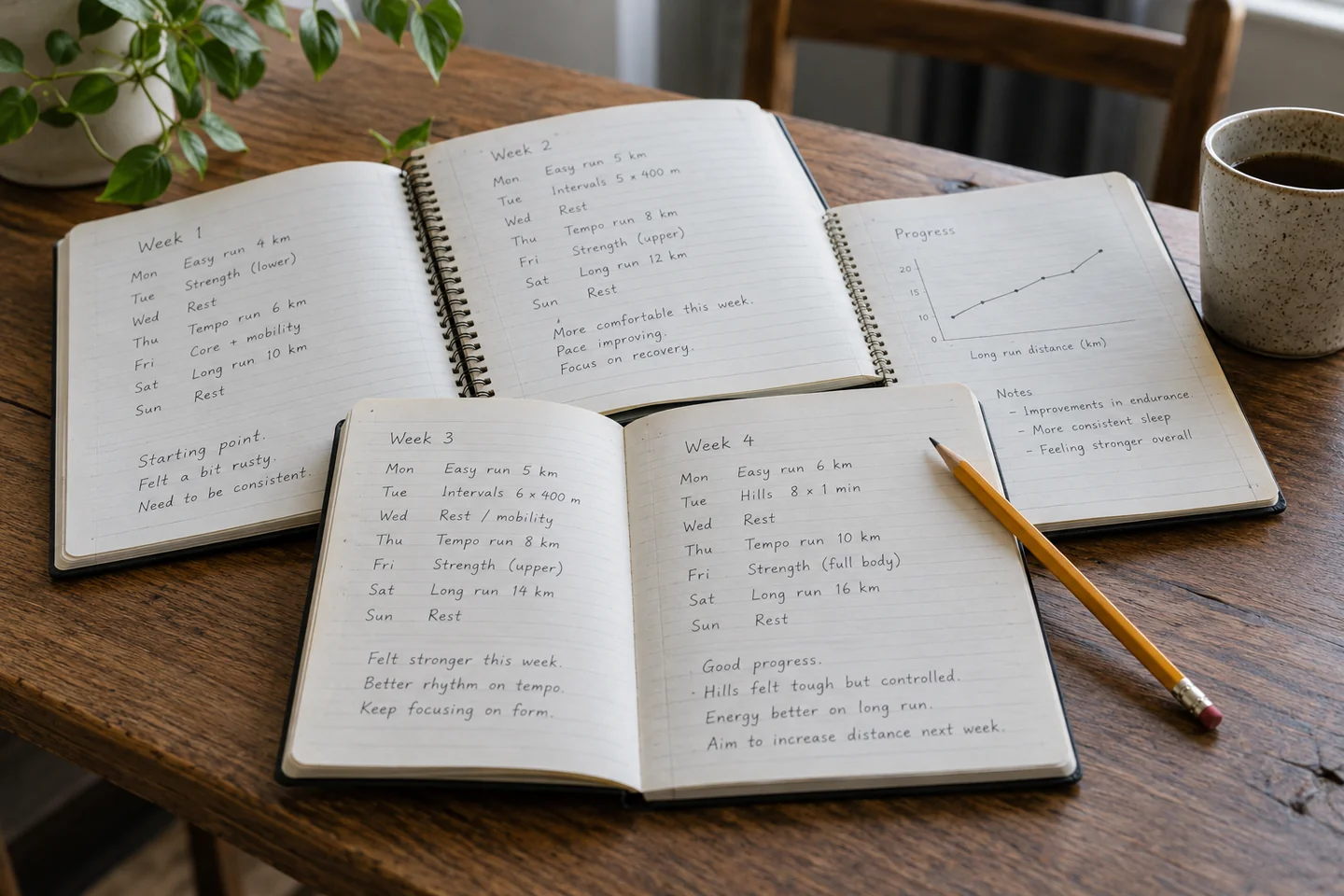
Line up like with like
Choose one exercise and read its recent entries together. Confirm that the equipment, setup and recording convention remained similar. A heavier number on a different machine is not a straightforward improvement on the earlier number.
Look for notes about changed exercise order, interrupted sessions or unusual waits. These details may explain a result before you reach for a physiological explanation. The log should help you ask better questions, not encourage a diagnosis from a few numbers.
Separate planned work from completed work. A programme that listed three sessions a week may have been performed once a week during a busy month. Judge the record you have, rather than the schedule printed at the top.
Read more than the largest number
Consider whether repetitions have become more consistent, whether setup is clearer, and whether the session fits its time slot. These observations do not all measure the same thing, but together they explain how the routine is working.
Avoid searching only for personal records. If you select the best set from each month and ignore the surrounding work, you may miss recurring problems. Equally, one unusually poor entry need not define the whole period.
Notice whether a change had the effect you intended. If you moved the appointment to avoid queues, did the session become easier to complete? If you simplified the log, did the entries become more reliable? Administrative progress deserves its own evaluation.
Look at the quality of the information itself. Are some exercises recorded carefully while others have only a tick? Do the difficult sessions have detailed notes while the ordinary ones have none? That imbalance can make the history seem more dramatic than it was. Improve the recording habit before treating the gaps as evidence.
For a calendar review, count actual appointments and identify the common reason for cancellations. You do not need a complicated percentage. A plain finding such as three late finishes at work displaced the same evening slot is enough to support trying a different arrangement.
Turn a pattern into a question
Instead of writing no progress, be precise: the final exercise is often omitted, the next dumbbell is a large jump, or the repetitions vary after a short night. Each statement leads to a different conversation and a different possible adjustment.
If a coach is involved, share a small relevant section of the log rather than an unfiltered archive. Include the context they need and explain the question you want answered. A handful of accurate entries can be easier to interpret than a dashboard full of unrelated scores.
Keep health concerns separate from programme analysis. Persistent unexplained fatigue, pain or other symptoms deserve appropriate professional advice; a spreadsheet cannot establish their cause.
Choose the next review point
You do not need to re-evaluate the entire programme after every visit. Pick a sensible occasion to look again, such as the end of the current block or a scheduled discussion with your coach.
Leave one clear note about the next decision. That might be to maintain the arrangement, clarify a progression rule or change an unreliable training time. A review is useful when it improves the next few appointments, not when it produces more charts than questions it can answer.