Work backwards from the rest of the evening
Start with the time you need to be up the next day and the household responsibilities that follow training. Travel, washing, preparing for morning and winding down all take time. A session ending at ten does not mean the evening's tasks end at ten.
Write the sequence once using realistic estimates. This may show that the gym visit itself fits but the journey does not, or that a long session leaves little room for anything afterwards. Those are useful distinctions because they suggest different changes.
If you share a home, consider noise and access to the bathroom or kitchen. A late routine that repeatedly wakes someone else may need a different arrangement even if your own timetable appears workable.
Avoid planning around the fastest possible version of every step. A delayed train or occupied shower should not turn the entire evening into a race. A little margin can make the arrangement less fragile.
Distinguish access from suitability
A gym staying open late solves the access problem. It does not by itself establish that a particular late session suits you. Notice how the arrangement works over several ordinary evenings, including whether it leaves enough opportunity for sleep.
Responses to timing can differ. Rather than claiming that everyone should or should not train at a particular hour, consider your experience and seek appropriate advice when sleep is persistently difficult. Do not rely on a single good night or bad night to explain every effect.
If a coach writes your programme, explain the timing constraint. A session designed without knowing that you reach the gym near closing time may require revision. Ask about an appropriate shorter version rather than simply rushing the same list.
Check which facilities and staff support are available at that hour. A building may be open while induction, classes or staffed areas operate on a different timetable. Unfamiliar equipment should not be left to a moment when you cannot obtain the help you need.
Remove avoidable late tasks
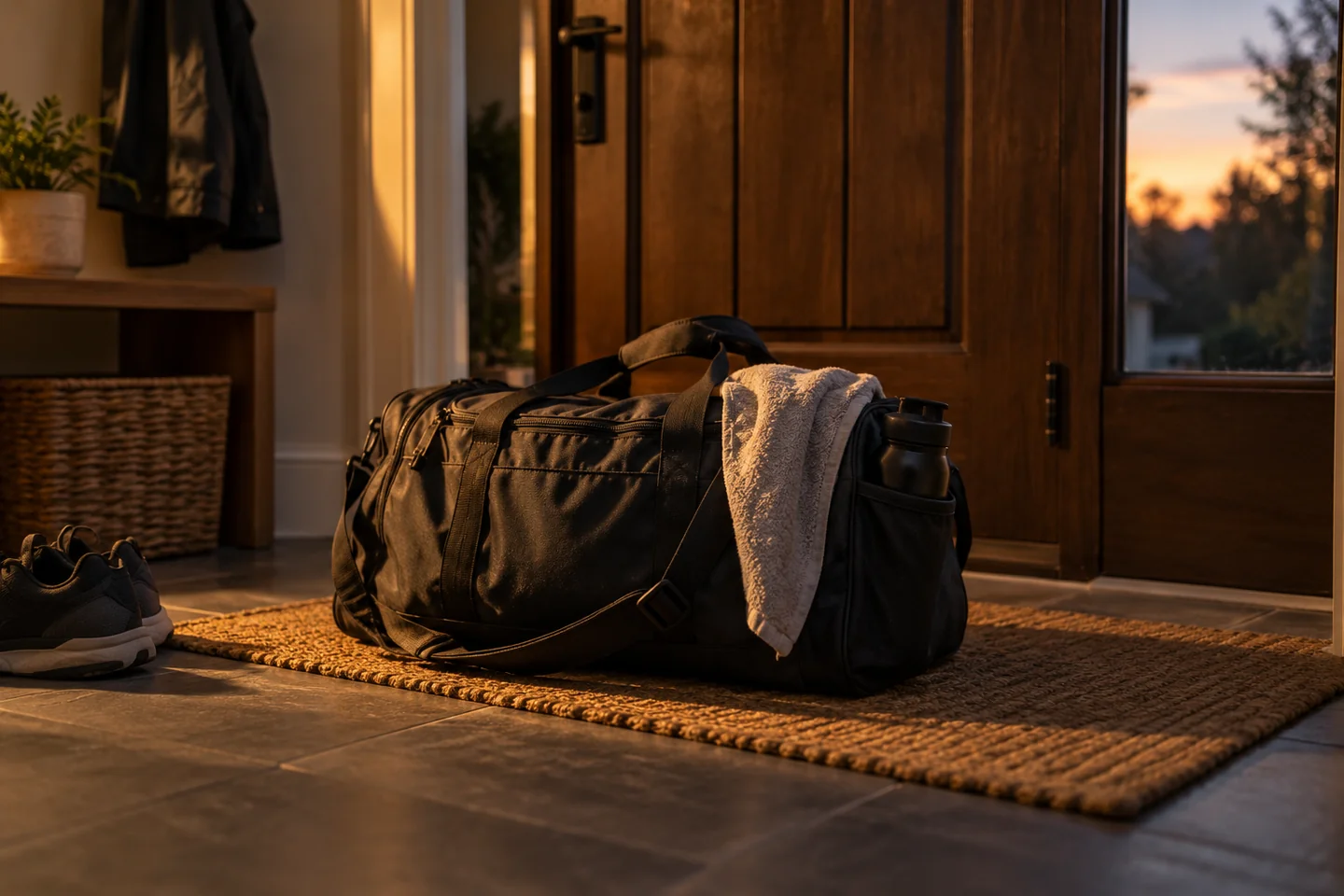
Pack the bag before the day becomes busy. Leave clean clothes and the next morning's essentials ready. These arrangements do not provide a physiological recovery technique; they simply reduce the number of decisions waiting at the end of the night.
Complete the training record close to the session. A factual entry can be brief. Save programme comparisons, shopping and technique-video searches for another time if they tend to extend into a long screen session.
Plan how used kit will be handled. Taking damp clothing out of the bag and setting items where they can be cleaned or dried appropriately is usually enough for the immediate reset. The evening does not need an elaborate equipment-maintenance ritual.
If travel is the largest obstacle, compare other suitable options with their full practical demands. A nearer venue or a different appointment on another day may be more useful than trying to save a few minutes within every set.
Consider the trip home before the session starts. If public transport becomes infrequent late in the evening, missing one departure may add much more time than expected. A planned finish should include the walk to the stop and a reasonable margin. That practical boundary may be more important to the evening than choosing a supposedly ideal exercise order.
Keep the session's boundaries
Know when you need to finish and choose a plan that fits that boundary. Do not reclaim time by skipping necessary preparation, rushing unfamiliar equipment or omitting the rests the programme requires.
Leave time to return equipment and exit normally. Closing-time announcements are not an instruction to finish a set hurriedly. If the session repeatedly collides with closing, the appointment or programme needs to change.
Avoid adding work because the room is unusually quiet. An empty gym can make equipment access easier while still leaving the same bedtime and morning commitments. Availability is not a reason to extend the plan indefinitely.
If you train with someone, agree on the finish time beforehand. A shared conversation can be enjoyable without quietly adding half an hour to an already late evening.
Review the arrangement with sleep in view
The CDC's sleep guidance includes keeping regular sleep timings and a suitable sleep environment. The scheduling implication is straightforward: leave actual space for sleep rather than treating it as whatever time remains after training and household tasks.
If sleep problems continue or daytime sleepiness concerns you, discuss them with a healthcare professional. A training article cannot determine whether timing is the cause, and more monitoring is not necessarily the solution.
You may find that the late appointment works with a shorter session, fewer evening tasks or a different day. You may find it does not work well enough to keep. Either result is useful information.
The decision should reflect the whole routine, including the following morning. A session is easier to sustain when it has a defined place in the day and a clear end, rather than borrowing time from every activity that comes after it.