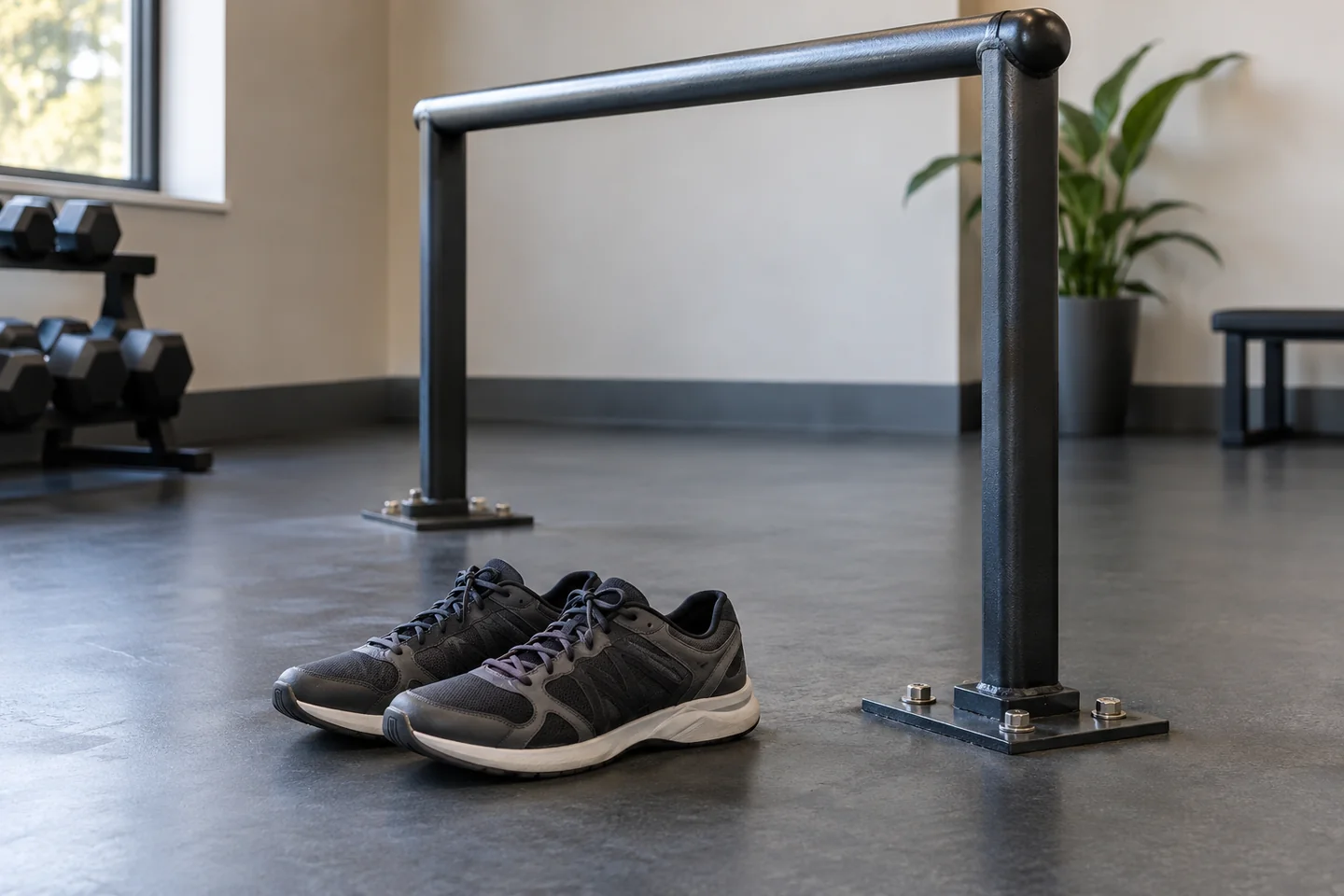
Use the support lightly
Stand on a firm, level surface near a wall or fixed rail. Place the feet comfortably apart and use your hands for balance. Rise onto the balls of the feet, then lower the heels gently to the floor. Keep the movement unhurried enough that you can notice whether both feet are doing broadly the same thing.
The support should not move when touched. Avoid leaning heavily into it or pulling yourself upwards with the arms. Move your feet nearer the support if you have to reach for it. If balance is distracting, make the rise smaller while keeping a secure hand contact. You do not have to let go to prove that the exercise is challenging enough.
Give the lowering phase some attention
It is easy to turn calf raises into a sequence of bounces. Pause briefly in the standing position between repetitions if that helps you separate them. Lower rather than dropping the heels, and keep the pressure through the front of the foot from suddenly rolling to its outer edge.
A step adds a different range because the heel can descend below the forefoot. That is not automatically the next version everyone needs. Learn the level-floor movement first and get advice before using a larger range if you have ankle, foot or tendon symptoms. Do not use a painful stretch as the measure of a successful repetition.
For a simple check, watch whether the last few raises remain about as controlled as the first. If the knees begin bouncing or the torso rocks to create height, end the set and reassess the difficulty. Adding a dumbbell also changes the balance task and takes away a free hand. Make that change only when you can arrange support and hold the load securely. Finishing with a deliberate return to flat feet is more useful than squeezing out a final wobbling repetition.