Separate the lift from the reach
First understand the intended movement without weights. A deadlift involves bending through the hips and knees to pick up a load, then returning to standing under control. A trainer can show the version suited to your experience and equipment. The depth of the starting position should let you establish that movement, rather than force a reach that you cannot organise.
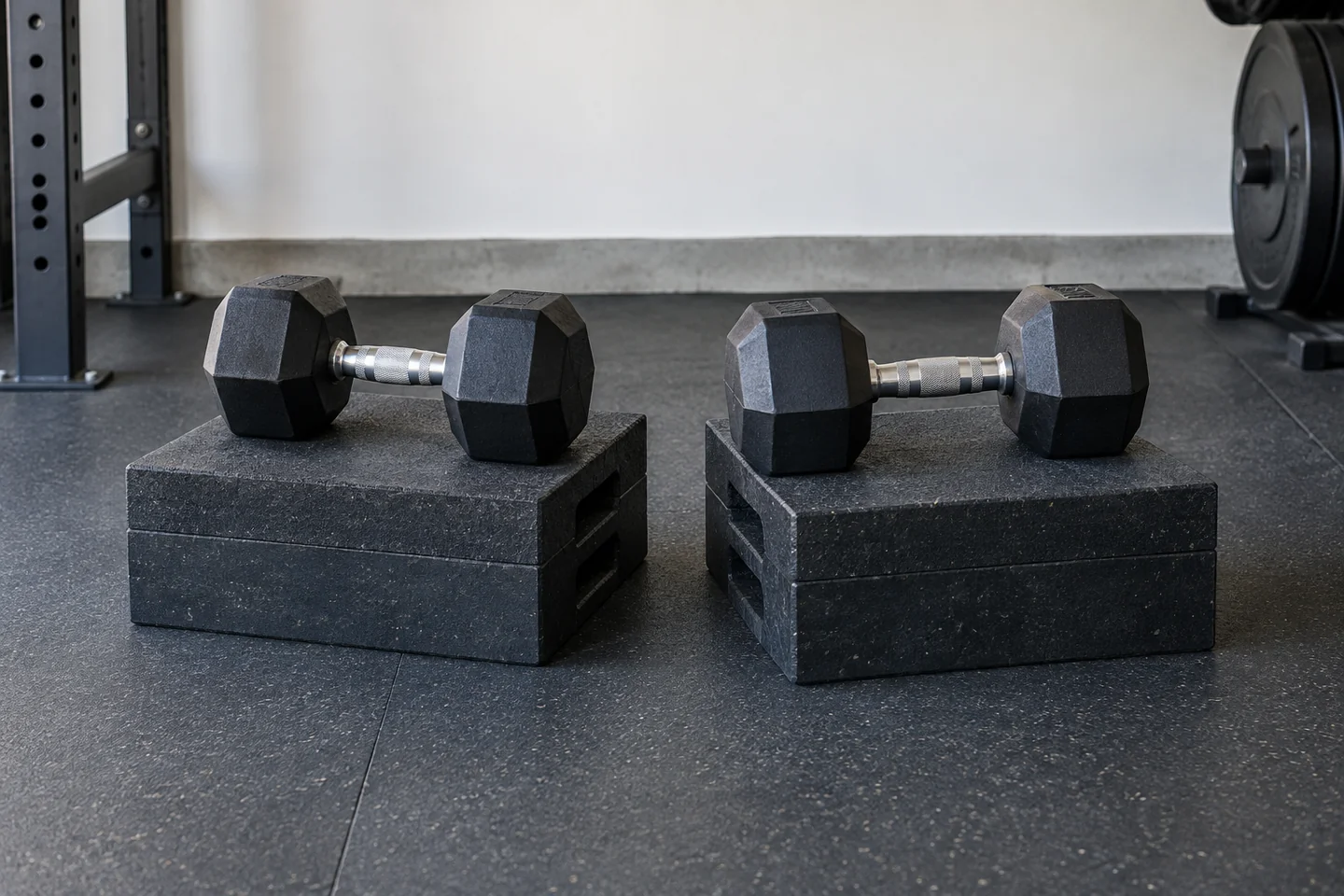
If a pair of dumbbells sits too low, stable lifting blocks or another purpose-made support can raise the starting point. The supports need to hold the weights securely and leave room for your feet and hands. Loose books, cushions and stacked household objects are not substitutes. Check the arrangement with very light weights before treating it as a working setup.
Raising the start is not the same as standing on a platform yourself. Those choices change the relative distance in opposite ways. Describe the actual arrangement when asking for help so there is no confusion about whether the weights or your feet are elevated.
Make the hand position easy to find
Set the dumbbells where you can grip them without reaching far away from the body. Their exact position depends on the variation you are learning. Keep them parallel or arranged as instructed, with enough space that the ends do not trap your shoes. Before lifting, take a moment to establish the grip rather than grabbing and standing in one rushed motion.
With a light load, stand smoothly and keep the weights close without dragging them against the legs. Finish tall, not leaning backwards. Return them to the supports deliberately, using the same general movement pattern. If the weights only find the blocks after a sideways search, make the landing area clearer or simplify the setup.
The handle size matters. A dumbbell can be modest in weight but bulky enough to make the grip or clearance awkward. Choose equipment you can hold securely, and do not assume that a long adjustable dumbbell will behave like a compact fixed one. The ends may meet the legs sooner even when the displayed load is similar.
Check the lowest position while it is still easy
The bottom of the movement is where a setup that seemed fine standing up often reveals its limitations. Can you place the weights without a sudden change in torso position? Are you still balanced over the feet? Can you release the handles without pinching the fingers against the support? These questions are easier to answer with a light trial than after a demanding set.
If the answer is no, change the height or seek feedback rather than increasing the weight. It may be useful to practise the hinge or squat components separately. A written description cannot determine whether your difficulty comes from the setup, the instruction or something requiring individual assessment.
Do not treat the supported start as a temporary embarrassment that must disappear quickly. It is a way of matching the equipment to the movement being practised. The useful range can be reviewed later. A lower start only makes sense when it serves the exercise and you can control it comfortably.
Plan where the set ends
Put the dumbbells down on the intended surface before relaxing your grip or turning to speak. Keep the blocks clear of other equipment throughout the set. If you must walk the weights back to a rack afterwards, first make sure the route is open and that the carry is manageable. The return journey is another task, not an automatic consequence of being able to complete the lift.
Note the support height along with the load if you are recording the exercise. Two sessions using the same dumbbells from different heights are not identical. A short entry describing the blocks or platform arrangement will make the next setup faster and any comparison more meaningful.
For a supported start, inspect the surfaces where the dumbbell heads rest. Both ends should be supported in a way that prevents rocking or rolling, with the handle accessible. A narrow block that leaves most of the weight hanging over an edge is not a reliable landing area. Place the supports before selecting a demanding load and leave them in the same position for the whole set. If you want feedback from the side, place the camera outside the return path rather than where a weight might be set down. The support arrangement should remain simple enough that you can reproduce it without a new construction project each session.
When the starting position is consistent, it becomes much easier to notice a genuine change in control or effort. That is the point of arranging the height: it removes an arbitrary demand imposed by the size of the dumbbells and lets you practise the lift you intended.