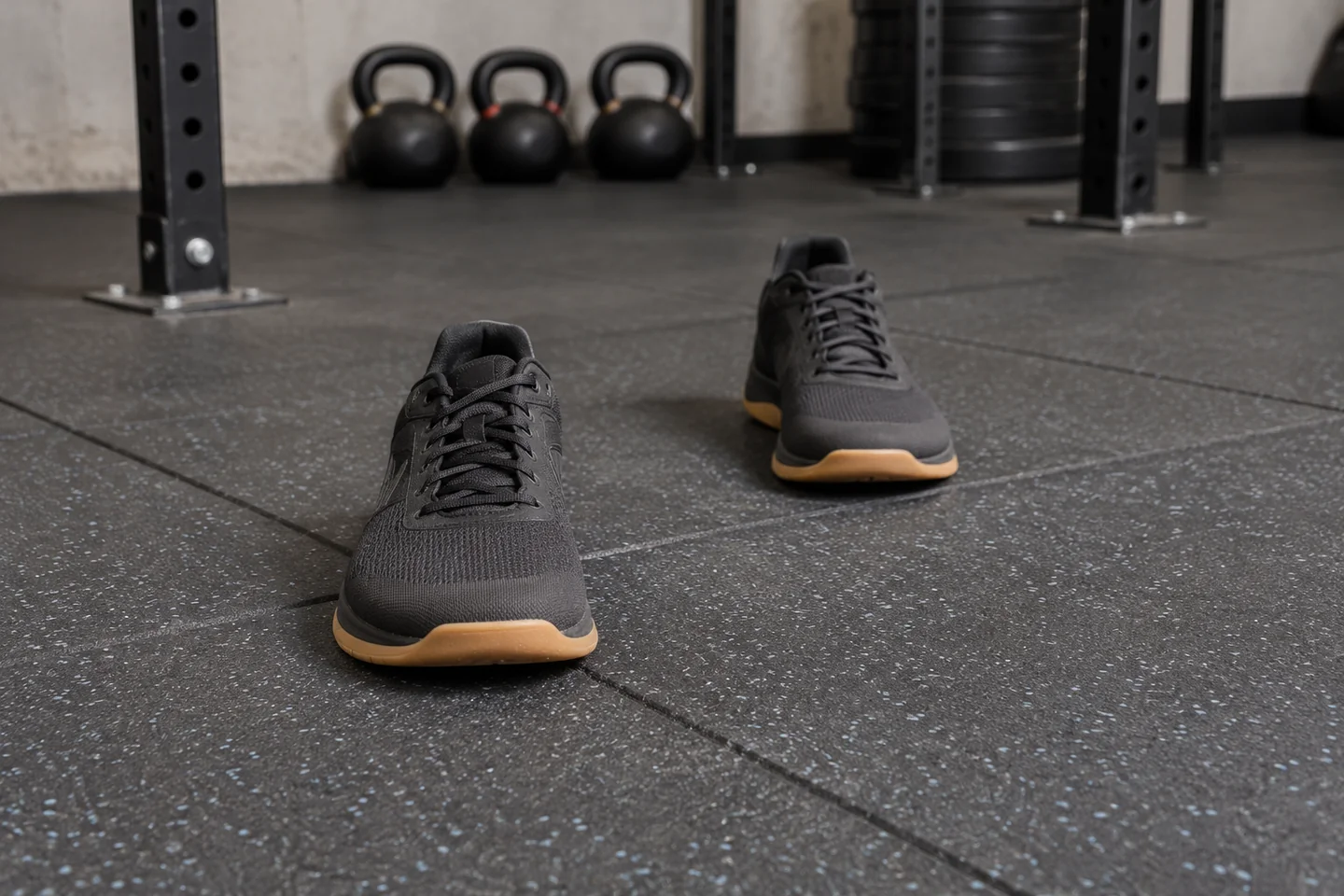
Leave space from side to side
Imagine two narrow parallel tracks rather than a tightrope. One foot stands ahead of the other, but they do not have to share a single line. A little lateral space gives you a more usable base from which to practise. If your feet are almost heel-to-toe, a small sway can become the main event before the legs have done much work.
Start without weights. Step one foot back a comfortable distance and let its heel lift naturally. Keep the front foot settled. Make a shallow bend through both knees, then return to the starting height. You do not need to lower the rear knee close to the floor on the first attempt. This is a chance to understand where you are standing.
Try the other side separately. It may need a slightly different first adjustment to feel organised. That does not by itself reveal an injury or a major imbalance. Foot placement is a skill, and copying the first side exactly by eye can be surprisingly difficult. Give each side a calm setup rather than rushing to alternate.
Separate stance length from depth
A very long stance may pull you into a position you cannot control; a very short one can feel crowded. Change the front-to-back distance a little and make another shallow repetition. Keep the width broadly similar so you can tell what the length adjustment did. Once you find a workable distance, explore a comfortable amount of lowering.
Think about descending between your feet instead of throwing your torso forwards to reach a target. Some forward torso inclination can occur naturally, but an abrupt tip is a reason to simplify. The whole movement should remain something you can reverse without a scramble. If balance dominates, use a fixed support with a light hand contact while learning, rather than grabbing a movable chair.
A support is useful only when it lets you practise the intended movement. Pulling hard with the arm can disguise an arrangement that still feels awkward. Place the support where your hand can rest comfortably, keep the trial easy and ask a trainer for a demonstration if you cannot make the position work.
Choose the version deliberately
A stationary split squat keeps the feet in place. A reverse lunge steps back and returns. A rear-foot-elevated split squat adds a raised support. These names are sometimes used casually, but the transitions and equipment are different. Learn the version actually written in your plan instead of borrowing instructions from whichever video appears first.
Keeping both feet on the floor removes the problem of finding a rear support of the right height. It also makes it easier to stop, reset and compare small stance changes. There is no obligation to elevate the back foot to make the exercise count. A simple setup can still require attention and effort.
Likewise, holding dumbbells is an additional task. You must get them into position, keep them clear of the legs and put them down afterwards. If you are still concentrating entirely on where your feet should go, leave the weights aside. A stable repetition without load provides a better starting point than a heavier one interrupted by repeated balance corrections.
Keep the exit easy
After the last repetition, stand comfortably before stepping the feet together. Avoid twisting suddenly out of a low position, especially while holding weights. If you use support, keep it available until you have returned to a normal standing stance. The transition out of the exercise is part of the setup worth practising.
For your next attempt, remember the details that helped: a little more width, a shorter step or a shallower descent. You do not need to attach a medical explanation to each adjustment. Record what you can observe and repeat. If the position causes pain, stop and seek individual guidance rather than experimenting with increasingly extreme foot angles.
Before changing exercises, check whether your front foot stayed in the same place throughout the trial. A foot that gradually creeps forwards makes the final repetition a different stance from the first. Reset between attempts rather than shuffling continuously while lowered. If you use a floor reference, keep it flat and unobtrusive; a raised object beside the foot can become an obstacle. This small observation often makes the practice easier to describe when asking an instructor for feedback.
The useful outcome is a stance you can enter, move within and leave under control. Once that is familiar, changes in load or movement become easier to evaluate because they are built on a position you already recognise.