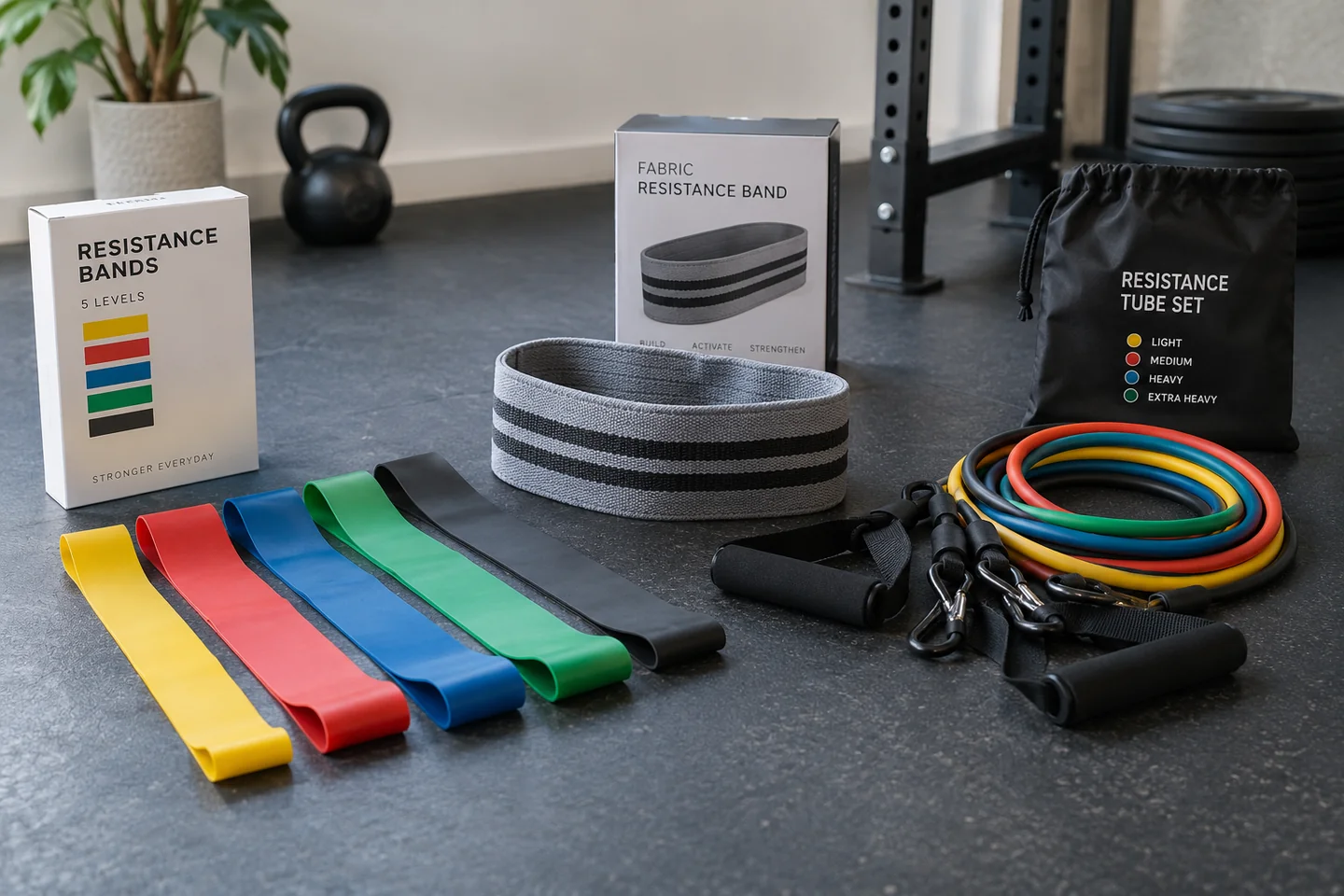
Read the maker's scale
One brand may use a colour for a lighter band while another uses it for a different resistance. Even within a brand, separate product lines can have different dimensions and ratings. Keep the packaging or official chart that belongs to the exact band. A chart found online is useful only if you can identify what it describes.
Band resistance also changes as the material stretches. A force rating may be measured at a specified elongation rather than applying equally throughout an exercise. That is why a single printed kilogram or pound value should not be treated as identical to holding that weight in a dumbbell.
If the product provides a range, read what the range means. Do not select a band by comparing only the largest number on two different listings. Dimensions, construction and testing conditions may differ. When information is unclear, ask the manufacturer rather than inventing a conversion.
Keep your own setup recognisable
For exercise notes, record the brand or product type, colour and relevant arrangement. With an open band, the grip length matters. With an anchored band, your distance from the anchor matters. Pulling the same band from a shorter starting length can change the difficulty without changing its colour at all.
This does not mean you need laboratory measurements for a home session. A consistent, approved setup and a clear description are usually more useful than false precision. You might note which marked grip points you use or where you stand relative to a fixed feature, provided the product permits the arrangement.
Avoid using knots or arbitrary extra wraps to recreate a remembered resistance. Those changes can affect both the tension and the way the material is loaded. Follow the maker's limits and ask for instruction if you cannot make the exercise fit the band's length.
Treat another band as another trial
When replacing a worn band, start gently even if the new one has the same colour. Confirm the product identity and assess the intended movement with control. Age, wear and a different model can all make the experience unlike the old setup.
If several people use the same kit, identify the bands in a way everyone can understand. Keep the original product names on their storage pouches rather than calling one 'the easy band', since that description depends on the exercise and person. Do not write on or cut the elastic unless the maker allows it. Clear storage labels can preserve the product information without changing the material itself.
If the next colour in a set is much harder, there is no requirement to use it immediately. The available steps in a product range do not dictate your progression. A trainer can help adjust the exercise appropriately. A colour is a convenient reminder of which item you selected, while the movement, stretch and control explain what that selection actually meant.