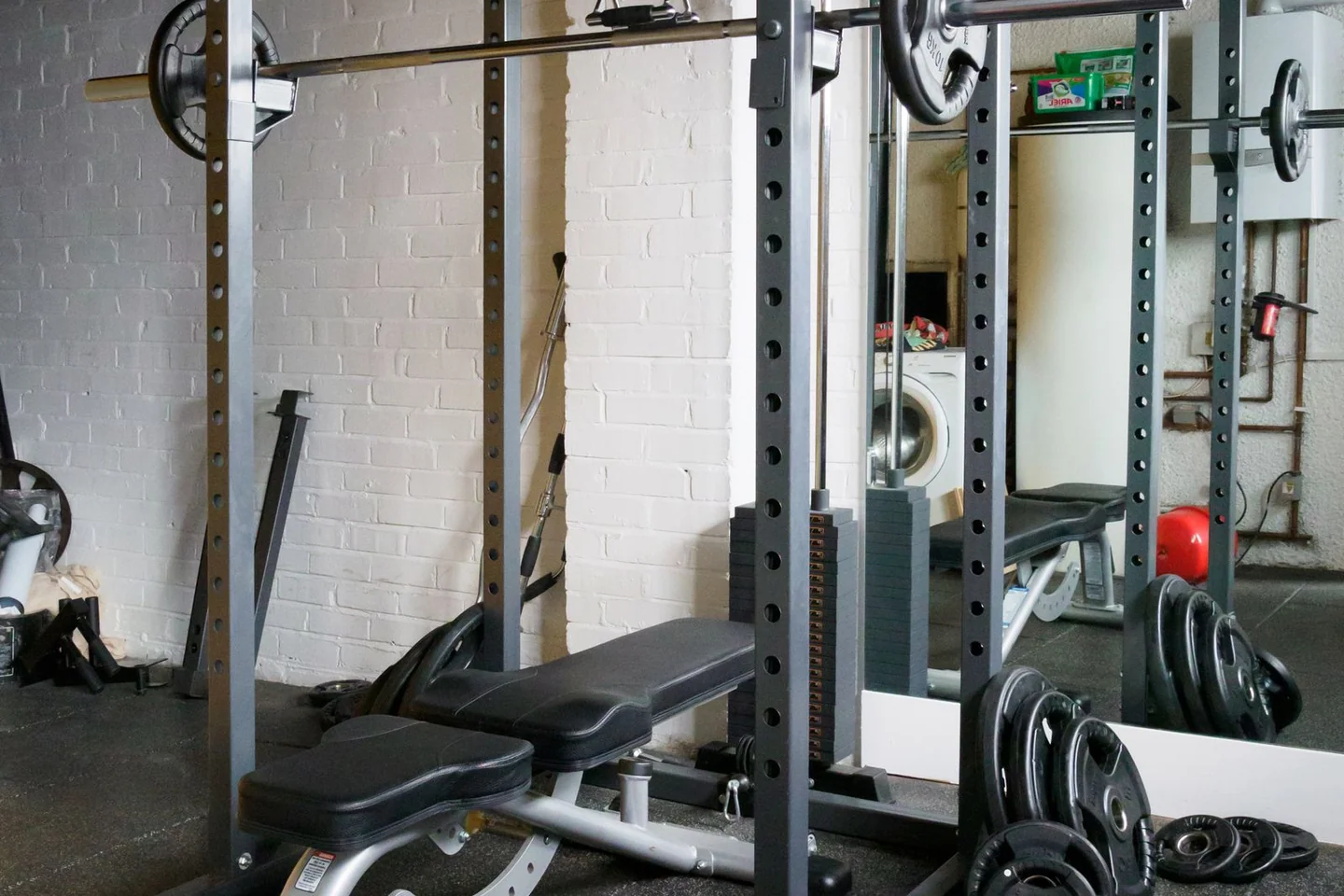
Draw the used footprint
Measure the bench at the settings you intend to use. An adjustable backrest can change the outline, and wheels or handles may protrude beyond the pad. Mark the dimensions temporarily on the floor, then add the space needed to sit down, lie back and stand up without meeting furniture.
Rehearse the intended movements without weights. For a press, the arms travel beyond the edges of the bench. For a supported row, one side needs clear floor space. For a seated overhead exercise, the height above the bench matters. The equipment can fit neatly into a corner while none of those movements fits comfortably around it.
Include the weights in the plan. You need a safe place to collect and put them down, not merely somewhere to store them between sessions. A pair squeezed between the bench and a wall can require an awkward reach before the exercise even begins.
Check the floor and support
Use the bench on a level, suitable surface and follow the manufacturer's requirements. A thick soft rug may allow rocking even when the frame is sound. Protective flooring should not create an unstable base or conceal a loose foot. Check the bench without weights before each use if it has been moved.
Read the load rating carefully. The specification may refer to a combined user-and-weight load, and different positions can have different restrictions. Do not assume the largest number in a listing applies to every configuration. The official instructions should explain how the rating is intended.
Assembly and maintenance matter as much as dimensions. Confirm that the appropriate hardware is fitted and adjustments engage fully. If you cannot verify the assembly of a used bench, get the correct manual or competent help before exercising on it. An appealing price does not resolve uncertainty about missing supports.
Think through storage separately
A folding bench saves space only if you can fold, move and store it as instructed. Check its folded dimensions, weight and approved storage orientation. Some benches are designed to stand upright; others are not. Leaning a heavy frame against a wall is not a substitute for an approved upright-storage feature.
Consider the route between storage and use. A bench that fits in a cupboard may still be difficult to manoeuvre around a tight doorway. Avoid a daily routine that requires carrying it over other equipment or lifting it from an awkward position. Convenience is part of whether the purchase will suit the room.
If it shares space with household furniture, decide what moves and where. The displaced chair should not block an exit while the bench is open. Keep the change simple enough to repeat, especially if other people use the room soon afterwards.
Decide whether the bench is needed yet
Some exercises can be performed in other learned variations without a bench, but those variations are not automatically identical. A floor press has a different range; a standing exercise changes support demands. Ask a trainer which options fit your current programme before buying equipment solely because a video uses it.
Renting or trying a bench at a gym can clarify which features matter. You may discover that a stable flat bench is sufficient, or that adjustability is important for specific exercises. That experience is more useful than collecting as many backrest positions as possible on a specification sheet.
A paper outline on the floor can make the decision more concrete. Mark the frame dimensions, then stand where your feet would be and extend your arms through the intended movement without a load. Add the space needed to lift the backrest and operate its control. You may find that a cabinet door cannot open when the bench is in use, or that the walking route narrows at the foot end. Those are useful discoveries before delivery.
Check the access route into the room as well. Packaging dimensions can be larger than the assembled footprint, and some frames do not fold for transport. Measure narrow doors or turns if they may be a problem. An equipment purchase should not depend on discovering at the doorstep that the box cannot reach its intended space.
A bench placed for one exercise may need moving for another. For example, a supported row can need more space along one side than a seated press. Decide whether that relocation is easy enough to do with the weights put away. If moving it requires dragging the frame across an unsuitable floor or squeezing between furniture, reconsider the room plan. One carefully chosen position may serve several exercises, but it needs to be tested with those exercises rather than assumed from the bench's rectangular outline.
If the room cannot provide the working clearance, choose a different setup rather than accepting a permanent obstacle course. The bench is one component of an exercise space. A good fit means you can enter, move, put the weights down and leave the area comfortably, not just close the door around the frame.