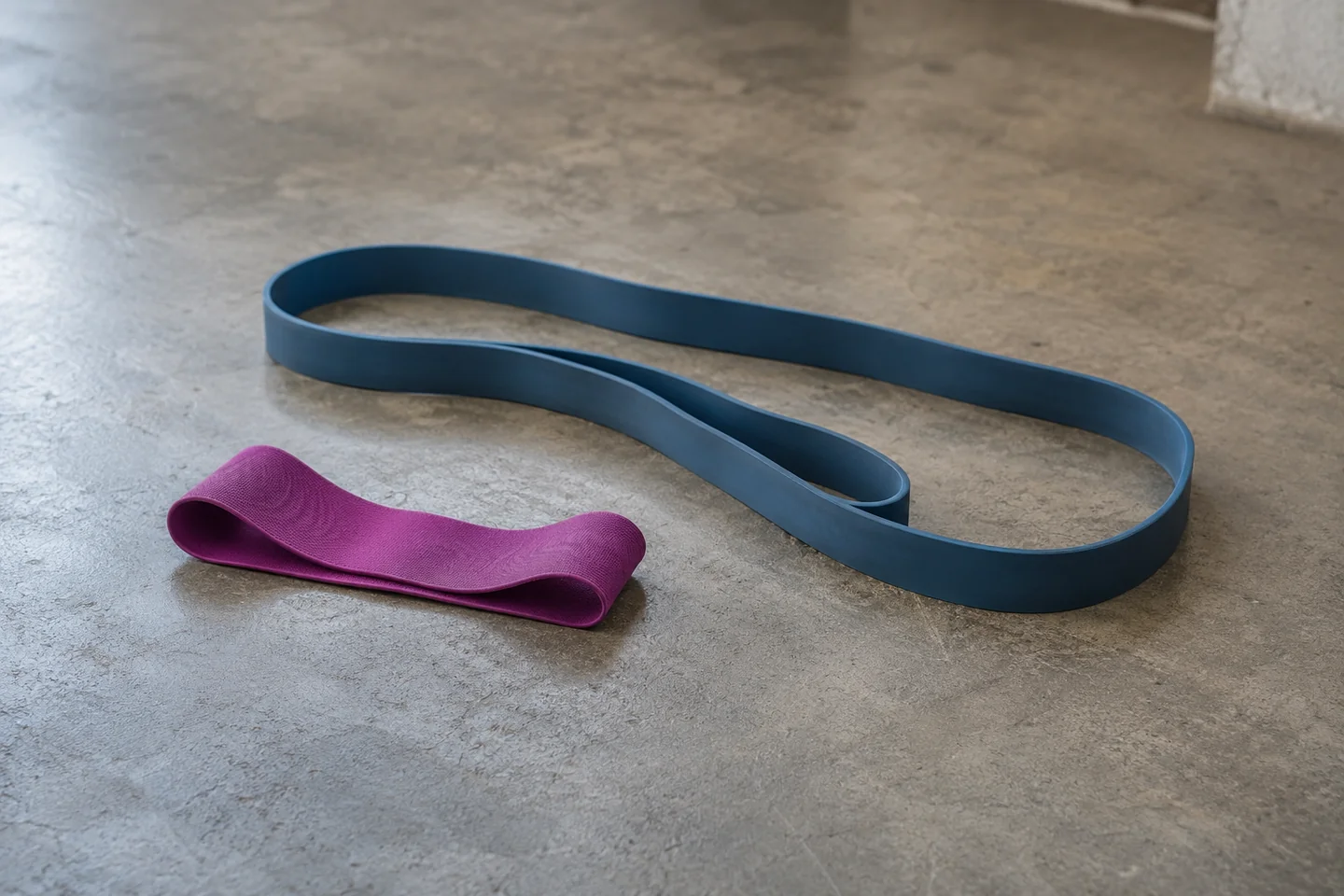
Look at the shape before the colour
A short loop is often intended for movements with a relatively small distance between its contact points. A long loop can span a larger distance and may be used in other approved setups. Flat open bands and handled tubes add further variations. Start with the exercise instructions and the manufacturer's intended use rather than assuming every elastic product can replace every other one.
Length changes the amount of stretch produced by a given movement. A short band pulled across a long distance may be overstretched even if its colour is described as light. Conversely, a long loop may have too much slack for the exercise you expected. Do not compensate by wrapping it around joints or tying improvised knots unless the maker explicitly permits that arrangement.
Material affects how the band feels against clothing and skin. Fabric-covered loops, latex loops and latex-free products have different care requirements. If you have a known material allergy, check the actual composition rather than assuming a fabric surface means no latex is present.
Buy for a named use
Before ordering a set, identify two or three exercises you already understand and check which band type they require. A bag containing many colours can still contain none of the length or construction you need. Product dimensions and instructions are more informative than a photograph of several bands arranged together.
Inspect any new band before its first use and read the stretch limits. Keep its identity clear in storage so you can find the right one again. A label on the storage pouch may help when the band itself has little marking.
If an exercise description says only 'use a band', ask for clarification before improvising. The missing detail might be the entire setup: short loop, long loop, open strip or handled tube. Getting that answer is usually more useful than trying to make the equipment you happen to own fit an unclear instruction.