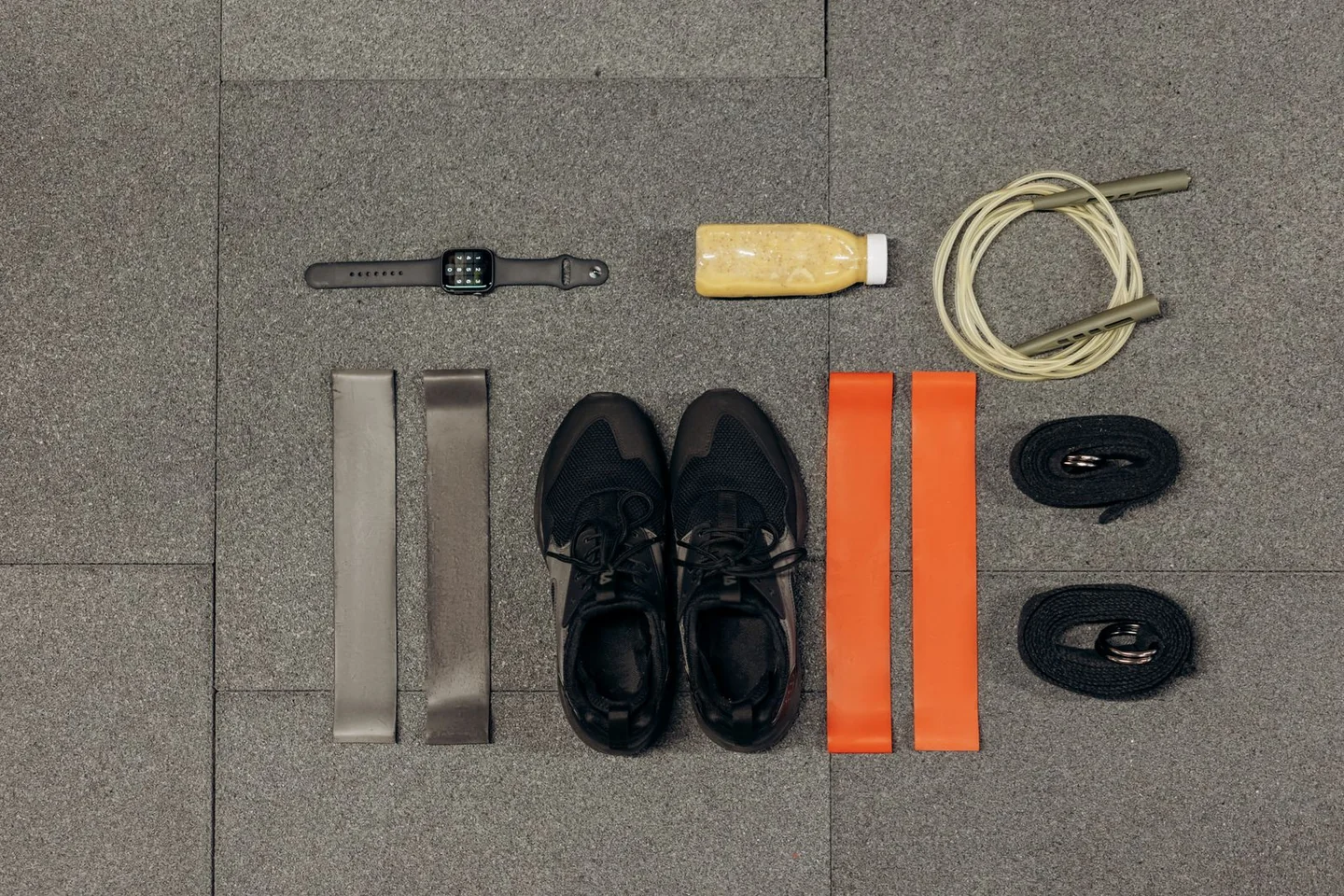
Write the equipment list from the movement list
Take a few exercises you have learned and note what each actually requires. Some need only clear floor space. Others need a mat, an appropriate weight or a particular band. Avoid starting from a large bundle and trying to invent uses for every piece it contains. A kit is useful because of what you can do with it, not because it has many components.
Be precise about the equipment. A short fabric loop is not a replacement for a long resistance tube, and a soft floor cushion is not a weight bench. If the exercise instruction is unclear, ask before buying. One clarified detail can prevent an entire unsuitable purchase.
Consider what is already available and suitable. A sound mat you know may be enough for floor practice. Existing weights can remain useful if they are manageable, intact and appropriate to the exercise. Replacing equipment merely to make the kit visually coordinated does not add a training function.
Give each item a place
Measure the area you use, including movement beyond the mat. Then measure the storage area. A piece of equipment has to fit both arrangements: being compact in a cupboard does not mean it can be used in a narrow gap between furniture.
Keep heavy items on a stable, suitably rated support and bands away from sharp edges. Store the pieces so that setting up does not require emptying a whole cupboard. If an item is always buried under other objects, its real cost includes the effort of retrieving and replacing it.
Plan the route through the room while the kit is in use. Spare weights and a rolled mat should not block the doorway. If the household shares the space, make it easy to return the room to its usual purpose. A kit that can be put away properly is more likely to remain compatible with the home.
Spend on the limiting detail
You may discover that the next useful purchase is a lighter pair of dumbbells rather than a heavier one, or a suitable storage stand rather than another resistance tool. Let the limitation come from actual use. What prevents the intended exercise from being set up comfortably and repeated?
Read the specification in that context. Weight increments, handle dimensions, material allergies, cleaning requirements and assembly can matter more than the maximum load or number of accessories. Check instructions before purchase when possible, especially for equipment with anchors or locking mechanisms.
Do not assume a cheap multipack is economical if several pieces will remain unused. Equally, an expensive item does not become necessary because a demonstration features it. Compare the function you need with the product's actual design and the room available.
Leave space for learning
A small kit will not replicate every gym exercise. That is a boundary to work with, not a defect that needs immediate shopping. A trainer can help choose suitable variations using what you have, while recognising that substitutions change the task and need their own instruction.
Keep a short note of what each item is for and its care requirements. This is especially helpful for similar-looking bands or adjustable parts. It prevents a growing collection from becoming a drawer of unidentified equipment with missing instructions.
A useful test for an accessory is to describe the problem it solves in one sentence. A second lighter pair permits a movement that the current pair makes too difficult. A storage tray keeps round weights from rolling. A compatible anchor permits a learned band exercise in an approved doorway. These are specific functions. If the explanation is only that the accessory makes the room look more like a gym, you can wait.
Keep compatibility in mind when adding pieces. A connector, plate or replacement handle should be approved for the system it joins. Similar dimensions do not establish that mixed parts will work safely together. Buying fewer clearly identified components can make the kit easier to maintain than assembling a collection of unrelated bargains.
Try writing a packing list for setting up one session. If the list includes a mat, one pair of dumbbells and a band, arrange their storage in that order of use. If it includes equipment you never actually touch, remove it from the active area rather than leaving it as clutter. This is a way to simplify the room, not a requirement to make every session identical. You can keep less-used items elsewhere and bring them out for a specific learned exercise when needed.
Review the kit after using it for a while. Which pieces are consistently useful? Which create setup problems? What specific exercise need remains unmet? Those answers provide a clear reason for the next change. A home kit can grow gradually while remaining small, coherent and easy to use, because each addition solves an observed problem rather than a hypothetical one.